
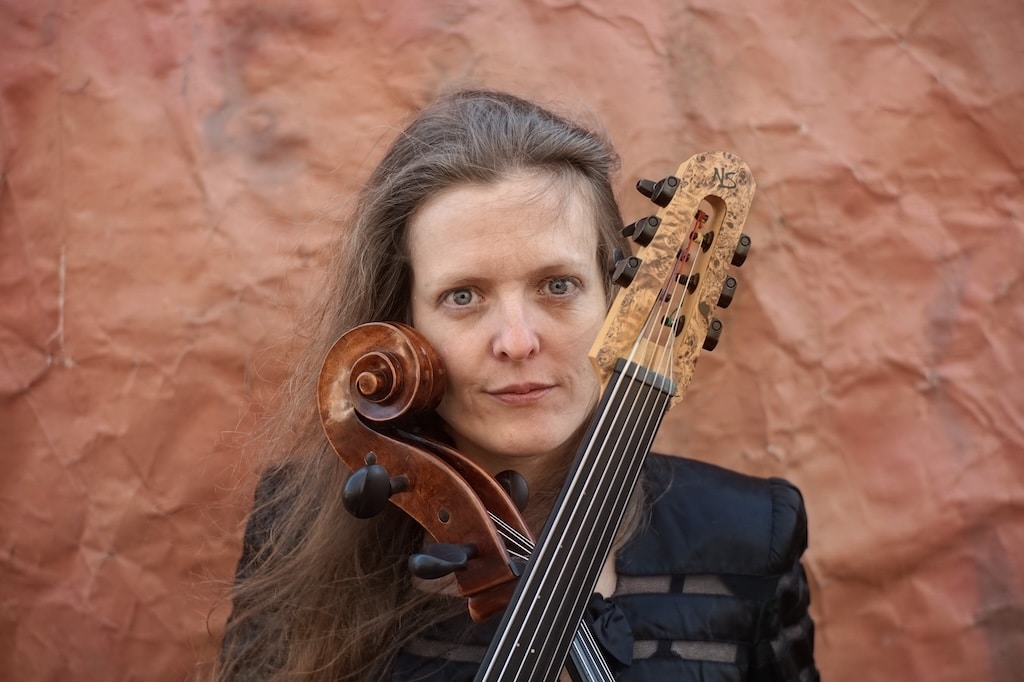
Christina Ruf spielt das sechsseitige (E-)Cello und komponiert. Der Klang des Instruments gefiel ihr auf Anhieb; und dennoch wollte sie nicht einfach dem Pfad folgen, das klassische Repertoire weiter und weiter zu repetieren. Einblicke in ihren Weg und ihr Schaffen gab sie im Gespräch mit dem moldovisch-amerikanischen multidisziplinären Künstler Serge Bulat – ein Gespräch also, das zwischen zwei Künstler:innen geführt wurde und so einen anderen, beinahe poetischen Blickwinkel einnimmt. Um diese Charakteristik beizubehalten, veröffentlichen wir das Interview in der Sprache, in der es geführt wurde, auf Englisch.
PROLOGUE — The Space Before Sound
Some conversations begin long before a word is spoken. This one started weeks before Vienna—in the soft hours of listening, with the sense that Christina’s work demands a different kind of attention. Not observation, not a profile—something slower; something able to hold her music as it breathes.
Vienna, with its layered histories and interruptions, felt right for this meeting. A city where beauty and fracture coexist without apology. Where a waltz can be pierced by a single honk. A city that mirrors the tension in Christina’s work: elegance and rupture, fragility and insistence on truth.
I didn’t know what the conversation would become, only that it needed space—and that she would fill it with honesty.
INTRO — The Room Before the Conversation
The conference room at mica – music austria held a late-afternoon moody light that spilled across every corner. I played Christina’s newest record quietly as I waited, letting its textures settle into space. The music didn’t fill the room; it shaped it, subtly rearranging the air.
Her productivity demands a kind of reverence, and I wanted to meet her work in the present tense—to be fully in The Now with the record she had just released.
She arrived with a backpack almost as large as she was, the kind that suggests a life lived between places. She stepped in with grounded immediacy, as if bringing her entire present moment along. No preamble. Just being. Just life, here.
She speaks about her art like one might speak about shifting weather—lived, observed, constantly changing. She projects playfully into the future, imagining that her music might reveal its meaning decades from now, or be misunderstood in ways that remain true, as long as it’s felt.

Hinweis: Mit dem Abspielen des Videos laden sich sämtliche Cookies von YouTube.
PRELUDE — If the Instrument Disappears
If the cello disappeared tomorrow—what would still be yours?
Christina Ruf: The cello is deeply important to me, and I share a profound connection with this instrument—but it’s not everything. Even without it—and though I would miss it—there would still be ways for me to create and compose music.
So it’s not the tool—it’s the way you think, the way you hear.
Christina Ruf: It’s a combination of all those things—tools, thinking, and hearing. And with electronics, it’s already something else. The instrument expands—it’s not just cello with effects—it becomes a whole sound world.
The question hung in the room, playful yet probing. It framed the cello as both anchor and lens—a doorway into identity, improvisation, and the essence of music. From this moment, her story of origins, first rebellions, and how the cello found her unfolded naturally, like a note released into open air, shaping what came next.
MOVEMENT I — Origins, Ghosts, and the First Rebellion
You grew up in Upper Austria. What was the musical environment like?
Christina Ruf: Every child was encouraged to learn at least two instruments. We played music and sang together—it was very present in that sense. But it wasn’t a space for personal exploration. There wasn’t encouragement to become an artist—for that deeper, individual engagement with music.
And yet the cello found you—beyond that framework.
Christina Ruf: It did. But I never felt like a classical musician. I loved the instrument, but not the path—not the idea of repeating repertoire forever. I wanted to play music, not inherit it. That’s where the first rebellion started.
So you had to find your own way? Classical training can feel like a ghost we carry—something we respect but also resist. Technique, style, form… all of it can become a cage.
Christina Ruf: Improvisation was my way out—or my way in. Forgetting everything I’d been taught so I could hear myself again.
That’s the part people don’t talk about enough: the unlearning.
Christina Ruf: There’s so much history attached to the cello. I love Bach, I love parts of the repertoire, but I never wanted to live inside that world. I needed to free myself.
Was it an instant click with the cello?
Christina Ruf: Funny story—my brother brought one home and made the worst noises imaginable: just squeaks. But ten-year-old me heard it and thought: this is beautiful.
That makes sense. When I first heard Patio of Resets, it felt like a child’s mind trying to understand this new being—deciphering all those bending, creaking textures, trying to connect.
Christina Ruf: It was an instant crush. [She said it with a kind of amused clarity, as if the origin of her entire artistic life had been hiding inside a single squeak.]

Hinweis: Mit dem Abspielen des Videos laden sich sämtliche Cookies von YouTube.
MOVEMENT II — Improvisation, Electronics, and the Dialogue with the Unknown
Do you usually begin with improvisation? Or does it come later, once you’ve already found the shape?
Christina Ruf: It depends. Improvisation needs structure. Some improvisations go nowhere—they wander. I love the ones that feel like a place. A form. Something evolving. Silence returning. A gesture reappearing after time.
Often, I improvise, record everything, and later find the fragment that has life. Then I build: layers, combinations, textures. That’s my composition process.
Yes—the improvisations that already contain a kind of dramaturgy. Premeditated improvisation, in a way. Like they know where they want to go before you do.
Christina Ruf: True. And sometimes it’s the opposite—like with STRØM. I knew exactly what each piece needed before it existed. It was a flow. I heard it first, then recorded it. No searching—just following.
That’s rare. When the piece tells you what it wants. And with electronics—in your music they’re not just effects, they narrate. Do you let them lead?
Christina Ruf: They’re another voice. Sometimes they misbehave—a cable buzzes, a pedal glitches—and suddenly that’s the beginning of a piece.
It’s a constant back-and-forth. Some pedals behave unpredictably. They have their own logic. There’s a space between knowing your tools and letting them surprise you. You need both—control and surrender.
“You cannot plan magic”—as you said.
Christina Ruf: [smiles] Exactly.
And sometimes the machine talks back.
Christina Ruf: That becomes the dialogue.
Her sound lives between the physical and the abstract—the invisible edges where the electronics take over.
She spoke about improvisation the way some people speak about weather patterns—something you can study, anticipate, even shape, but never fully control. The music wasn’t just hers; it was a mediation with the unknown.
MOVEMENT III — Sound as Organism, Geography as Mood
When you work with the electric cello, do you feel like you’re shaping it—or that it’s shaping you?
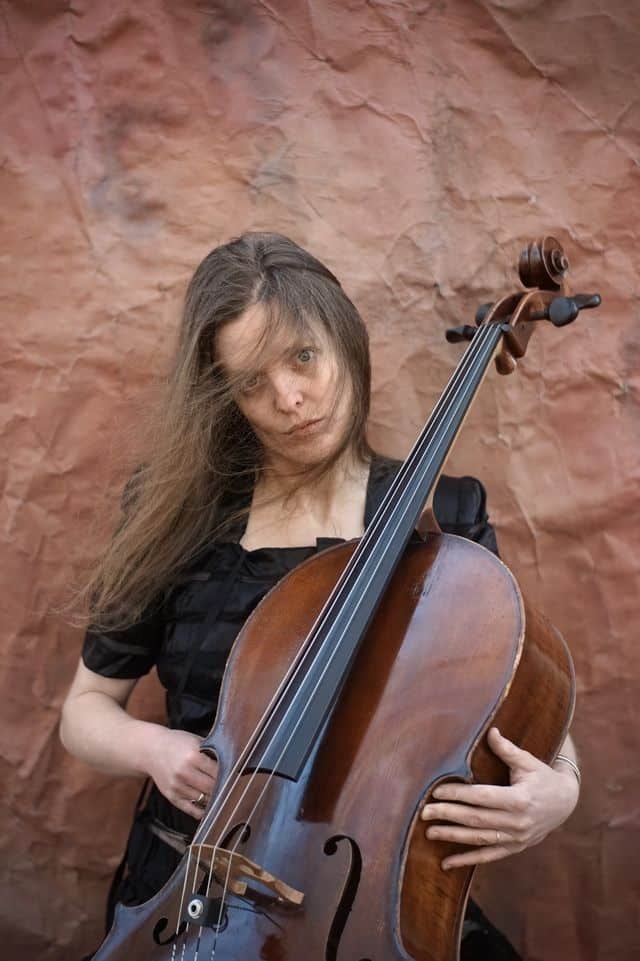
Christina Ruf: Both. I shape it through how I play, through the sounds I’m drawn to—the fragile ones, the flageolets, the raw textures.
But the instrument shapes me too. I’m listening while I play. It’s a feedback loop. Sometimes I feel like the cello knows something before I do.
That moment when the instrument stops being an object and becomes a character. An organism. Do you treat sound as space?
Christina Ruf: Sometimes. But I don’t think of it as architecture. It’s more like atmosphere, textures, structures, details—the grain of a surface, the silence between sounds.
Details as environment.
Christina Ruf: Exactly.
When you compose, do you begin with emotion?
Christina Ruf: I used to. At first, improvisation was very emotional for me. But eventually I realized there’s no need to be in a certain mood to create something meaningful. The music is already there to be found. Emotions are there too, of course—we’re human.
Do negative ones ever get in the way?
Christina Ruf: They did. Low self-esteem, a lot of psychological noise—it blocked everything. I couldn’t trust myself. The music couldn’t breathe. I had to work through that. Let go of inherited patterns. Become aware of them. Set boundaries.
Self-preservation.
Christina Ruf: It is.
You live between Denmark and Austria. Does geography affect your sound?
Christina Ruf: Denmark has silence. Nature. Time feels different. Austria has history. A heaviness.
Would you compose differently if you lived in Spain? A city like Barcelona—its rhythm, its sound—would you absorb it or resist it?
Christina Ruf: Both. I would allow it, but also resist it. It depends on the season of your life.
There was a softness in the way she said this—not uncertainty, but openness. Geography, mood, and sound felt like parts of the same shifting field.

Hinweis: Mit dem Abspielen des Videos laden sich sämtliche Cookies von YouTube.
MOVEMENT IV — Identity, Activism, Institutions
We’re living in strange times. It felt like things were moving toward real inclusion, and now it’s less clear. It’s impossible to abstract ourselves from what’s happening globally. Everything shifts constantly.
At the same time, it’s important to de-hypnotize ourselves from award shows. Reality is always more complicated. Where do you place yourself in all of that?
Christina Ruf: I hope for a future where it doesn’t matter. But we’re not there yet.
Were there examples—women or artists—who shaped how you see yourself in that landscape?
Christina Ruf: There were women who were important to me—like Sidsel Endresen. Hearing her voice was a turning point. But I wish I could name a hundred more.
And institutions?
Christina Ruf: They can still be quite conservative. When I studied, it was strict. And if you’re not good at writing about your work, you often don’t get in. The text around the art is often valued more than the art itself.
The framing around the work.
Christina Ruf: Yes.
And then there’s the avatar—the version of you people meet before they hear a single note. Do you find that exhausting?
Christina Ruf: It’s complicated. Social media is part of reality. But it takes time. If you don’t commit, it feels pointless.
I had to learn to separate myself from it, so it doesn’t swallow the work.
Christina Ruf: Yes. Expectations—the game of needing to fulfill them, whether your own or others’, is never helpful. It creates anxiety, pressure, a self-feeding loop. The only way is to do it without them: focus on the work itself, on the act of creating, and let that be enough.
And activism? I keep thinking about how quickly people judge each other online. We never know who acts quietly, who shows up without posting a thing. Silence on a feed doesn’t tell you anything about someone’s heart. And yet, speaking feels equally important.
Christina Ruf: I know what you mean. There are so many conflicts, so much suffering. Some choose not to speak out publicly, even though they have the reach or capacity to impact change. Everyone acts differently in that regard. I admire the work of activists who stand up and fight for human rights every single day.
In terms of social media, I’ve never posted anything political. Some people speak loudly. Others do things quietly. It depends on the person.
And the quiet forms of help … they matter too. The things no one sees.
Christina Ruf: Absolutely.
Narrator A stillness settled—not silence, but recognition. The conversation moved beyond art into what shapes it, acknowledging many forms of action, voice, and presence.
MOVEMENT V — The Sound of Vienna, Interruption, and the Fragility of Not Burning Out
What’s the sound of Vienna for you?
Christina Ruf: A waltz—this beautiful, elegant beginning. And then suddenly a car honk. Loud, intrusive. Like something breaking through the façade. The illusion of everything being fine … interrupted.
A train through a ballroom.
Christina Ruf: And then it ends. Maybe a trace of reverb. But the interruption—that’s the truth.
Is it a loop?
Christina Ruf: No. It happens once. One performance only.
I had the same experience meditating at MuseumsQuartier. I put on the Open app—headphones in, breathing—and then the city barged in: pounding from the street, the tram stopping, the subway rumbling underneath. Almost theatrical in timing.
Christina Ruf: That’s it.
With the monthly releases, I feel like your work exists as an ongoing conversation—with yourself and the audience.
Christina Ruf: It’s not about waiting to feel “ready” or making the album perfect. I release, move on, and continue. It’s strategy, but also a way to stay connected to the act of creating.
Touring and releasing alongside each other helps this, right? It’s not just album then tour—it’s multiple live experiments, evolving with each release.
Christina Ruf: That’s essential. It keeps the music alive, immediate, personal.
And if your music were found in some distant future, with no context or guidance, would you care if it was misunderstood?
Christina Ruf: I’m okay if people misunderstand my music. What matters is that it felt real at the time. There’s a learning process inherent in creation. You discover art gradually—sometimes years later, or through someone else’s connection.
That’s why continuity is so crucial. It’s not the product alone—it’s the accumulation, the conversation across time.
Just promise me one thing: don’t burn out.
Christina Ruf: Promise.
The promise hung there for a moment. Beneath us, the city moved—trams, distant shifts in pressure.
The conversation didn’t end. It tapered off—like reverb after the honk, leaving a subtle resonance beyond words, music, or performance.
OUTRO — The Quiet That Follows
When the conversation ended, something remained in the room. Not silence, not closure—just a charged stillness.
Her backpack rested at her feet, as if she hadn’t fully arrived or left.
What persisted wasn’t a single idea, but the way Christina holds contradictions without flinching: structure and improvisation, fragility and force, solitude and connection. She speaks about burnout as she speaks about sound—as something to meet with awareness, not fear.
EPILOGUE — After the Interruption
Art survives because artists do. Not through certainty, but through practice—the willingness to stay open, to listen, to let interruption become form.
Christina’s work points toward that.
In a world of noise, she chooses potential. In a world of speed, she chooses depth. In a world of interruption, she begins again—continuing to listen, respond, and create.
Links:
Christina Ruf
Christina Ruf (Bandcamp)
„Für mich war immer klar, ich will nicht am Cello ‚Cello spielen‘, sondern ich will am Cello Musik machen“ – Christina Ruf im mica-Interview