
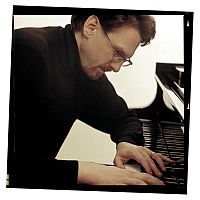
 Peter Madsen, 1955 in den USA geboren, begann bereits im zarten Alter von 8 Jahren klassisches Klavier zu studieren, zwei Jahre kam der Kontrabass hinzu. Mit 13 Jahren entdeckte er schließlich den Jazz für sich, in dem er sich in den folgenden Jahrzehnten an der Seite vieler international namhafter Größen einen Namen erarbeiten konnte, landete schließlich in Vorarlberg, wo er seine neue Heimat gefunden hat. Der Jazzpianist im Gespräch mit Peter Bader. Das Interview wurde in englischer Sprache geführt.
Peter Madsen (57), the American jazz piano-champion, who was once called “one of the greatest unknown jazz pianists“ in a NYC jazz magazine, has been living in Vorarlberg (Austria) since the year 2000. He is married to an Austrian woman, Elisabeth, with whom he has two little daughters: Olivia and Sophia. Madsen gives concerts in Europe, the USA, Canada, Israel, Russia and Japan. Besides his concert-life he teaches the subjects jazz piano and improvisation at the Jazz-Seminar Dornbirn. Many jazz musicians in the region have profited by his skills as a brilliant musician and careful teacher. It can be said that Madsen´s presence in Vorarlberg has increased the jazz education in this area to a higher level. He supports such young hopeful talents as upcoming jazz pianist David Helbock.
Now Madsen´s musical approach to the Seven Deadly Sins, which was part of the sucessful Theater Kosmos (Bregenz) production with the same title in January 2011, will be available on CD in January 2013. Interesting: Madsen and the theater company had the same idea at the same time: to write about one of the primary questions of Christian religion – the Seven Deadly Sins.
Madsen got together with the Theater Kosmos after he had mentioned to Brigitte Jagg, the sister of Augustin Jagg who runs the Kosmos, that he had already written music for the Seven Deadly Sins and was at that very moment in rehearsal when she told him that the Kosmos had just commissioned seven Vorarlberg writers to each write a part of a play about the Seven Deadly Sins. At first Augustin wasn’t thinking about having music for the piece but a couple of months later he decided he NEEDED music!!! They met once and of course he wanted to cut the music down to theater music length (very short) but Peter told him he wasn’t interested in that and suggested a new idea to have the music as important as the theater and make it a new experience for the audience as if they were attending a theater and a concert all in one!!
Although, Madsen originally didn´t mean his music to be a part of a theater play, it worked very well. The combination of Madsen´s eight pieces performed live by a jazz piano trio in combination with a string quartet and trumpet with actors and actresses and the different approaches of the seven male and female authors to the topic was an interesting experience for the enthusiastic audience, even though the underlying texts were of different quality – to say it politely. Although the production was also well received by the press, it may be said: Today, not yet two years later, no one talks anymore about the literary realisations of the topic. The thing which conquered the play is the music. It seems Peter Madsen´s music has no expiration date. His music will last.
Bader: You did not only write and arrange the music?
Madsen: I was aware of many things in the whole production. Besides composing and arranging the music, I also thought about a tasteful design for the CD-cover and shot photos myself for the front and back. I also wrote the liner notes myself as I enjoy writing and for a couple of years wrote monthly articles for an online jazz magazine called All About Jazz. The layout was designed by a pro. – Tom Beckham in New York City.
Bader: The photos show kinds of stylized flames if I´m right. The fire of hell for the deadly sinners?
Madsen: That’s right. I actually took the photos at night while around a large fire and I moved the camera in circles to get the wild moving flames effect. The front cover is supposed to be a heart created by a beam of light (which isn’t as clear as the original photo) through which one sees something mysterious and unknown. Actually I took the photo through the hole in a red hammock in bright light with my hand on the other side of the hole.
Bader: I’ve heard that at the same time when you thought about publishing your work another jazz musician in the states brought out a production with the same title you had on your mind: “The Seven Deadly Sins“!
Madsen: Yes! It worried me. And so I had to think it over. And I found a solution: I called my formation “Peter Madsen´s seven sins ensemble“ and my piece “gravity of love“.
Bader: By the way: Is there a little – funny – wordplay in the name of the group? Can we also read the band´s name with the accent of “Peter MADSEN´S seven sins“? I dare to ask this, knowing you as a man with a fine sense of humor, and after having read the text in your booklet, where you talk about a friend, whom you call “a wonderful sinner“…
Madsen: Ah yes, I love to play with words. And you once again have seen into my bag of tricks.
Bader: Looking at the musicians of your new ensemble, I recognize many of them as members of your “Künstler-Pool“ CIA – The Collective of Improvising Artists – which you initiated six years ago.
Madsen: That´s true. The “Madsen´s seven sins ensemble“ is a faction of the CIA. We have Herbert Walser on trumpet, horns & electronics; Dominik Neunteufel on double bass; Alfred Vogel on drums and percussion; Aleksandra Lartseva on violin, Monica Tarcsay violin, Simon Frick on viola and electronics and last, but not least Bianca Riesner on cello.
We first called it The Seven Deadly Sins Ensemble. By the way: You find a video of the Ensemble with THIS name on the CIA homepage, playing in the Porgy & Bess in Vienna in February 2012. But we changed the name for the CD. First we thought: “Let´s call it The Seven Sins Ensemble.” Then we added my name so the buyers of the CD in the USA would know that it was mine. Because without my name they would have no idea who the Seven Sins Ensemble was. So we needed to add my name for reviews and sales as there are people out there who know me.
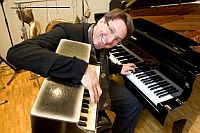 Bader: I saw that in the last twelve years you’ve been investing much time in the collaboration with musicians of the area. You support our Vorarlbergian (jazz) musicians, but you also demand a lot from them… Is it your wish to embed musicians of this area in your work?
Madsen: When I came to Vorarlberg more than twelve years ago, I took a good look around me who I could play with. And, sorry, I first saw noone. I had just arrived from NYC where there were tens of thousands of great improvising musicians. So I started my teaching. I had to create musicians to play with. It´s a principle of mine, to be aware and then to take care. “Awareness“ is one of the keywords in my life and then to take care and share. I need to be aware of what is and isn’t around me and then take time and energy to create what I might want or develop and to share my ideas with others. But, of course, there was also an egoistic motivation: I wanted to play! And: I learned a lot by teaching. I learned more about what the possibilities are and I learned much about myself, too. When one teaches one has to study and to organize one’s thoughts to be able to better explain to someone else what the possibilities are and how to try and move in the direction they are interested in. I never was a man with my nose in the air. I´m very curious, I don´t want to sit still. I wanted to become a better teacher. And a better writer. And a better musician. But yes I want to use mostly local musicians for the projects that I have created in Vorarlberg. This is of great importance to me. If I live in a community I want to be involved in the community. And now after twelve years I see a lot of wonderful high level musicians here in Vorarlberg. I guess my work is doing some serious good!
Bader: So you brought out the best of them.
Madsen: And hopefully the best in me. It is a New York-quality to always push the borders a little bit beyond, so that people have to reach, have to improve. To hand ideas over on a silver platter makes it too easy. We need challenges! So I try to let them grow naturally but always with a little carrot to get them to reach further. I leave space for my musicians to accent their strengths, like Duke Ellington did it.
Bader: Listening to your work, I recognize, that you give your musicians much space to unfold, to develop.
Madsen: I am always looking for the means and opportunities to allow the musicians I work with and teach to do their thing, to do what they feel the best at. I abdicated some solos. I gave one over to Simon for example on “avarice“ as I thought I was playing too many solos and I thought this would be a good piece for him to improvise on.
Bader: I think it can be said that it´s the first time that an ensemble of so many musicians from Vorarlberg appears on a New York-label. – The label of your friend and publisher Michael Mussillami, which is also the executive producer.
Madsen: I’m not sure but I guess that´s true.
Bader: Looking at the score of your music, I recognize that it´s very hard music, it´s absolutely NOT easy to play! Keyword: Odd meters! But: Listening to it, I wouldn´t guess! Isn´t it hard to write such complex music, which sounds easy, so natural, which sounds so, let me say: organic?
Madsen: I think you are right. It is hard to write complex music that also sounds appealing to the average listener. When I want to write such things I usually write by singing the melody first. If I can sing it usually will make a good melody to listen to and will feel organic. Even how I deal with odd meters 5/4, 7/4, 11/8 and 15/4 which I used in “Gravity“ is done in a logical way. Often I have a repeating bass line to hold those sections together. But sometimes not and this is where it gets really difficult. There are sections in “Gravity“ where different instruments are in different meters at the same time. Plus some of the rhythms I used within these odd meter sections are not very common and required a lot of rehearsal time.
Bader: So we have, as I see it, two important parameters in your composition: complexity and beauty. Can we compare your approach to composing music to a technic that is in the so called postmodern art forms common – namely working with different codes? In other words: On the surface – for the normal listener – your composition is beautiful music, but going deeper – for the specialist – there a riddles to be solved, very interesting things to be found.
Madsen: Funny you should mention postmodernism. I became interested in postmodernism when I was living with a postmodern feminist theologian in the mid-90s. She was a well known university professor who got me into it! But I am no expert! Your suggestion that “Gravity“ has many levels of qualities sounds correct. It has beauty and warmth on the surface but many complex musical concepts underneath. I think most good music like good art or dance or poetry or architecture has this quality.
Bader: Those who know you know that besides your abilities to create great melodies, voicings and sounds, you are a virtuoso in matters of rhythm. How important is the topic of odd meters for you?
Madsen: First of all odd meters and rhythm are two different and important musical tools to me. The work with the music from India, Africa and Eastern Europe has greatly influenced the jazz world the last ten years. These areas have been studied extensively by jazz musicians looking for new ideas to add into their music. The music of India and Eastern Europe utilizes odd meters extensively and the rhythmical concepts are at the highest level in the world! Also the rhythms of Africa and the concept of layering rhythms on top of each other continue to influence musicians today as it has throughout the history of jazz. I love to study these ideas and more as I hope to continue my musical growth throughout my entire life. I never want to rest on what I already know. There is so much more I need to do!
Bader: This means you are pushing your limits as well as the limits or the frontiers of the music you compose and play. Isn´t that in general what in the art form of Jazz always happened since it began?
Madsen: Jazz is a developing, growing art form. It´s open for every musical influence that exists in the world. Great music has to have newness, has to have surprise: And odd meters are a wonderful concept to give that to jazz music. In the last ten years odd meters became popular again in the jazz world. Of course, Dave Brubeck, who I like very much, did it already in 1959, when he recorded “Take Five“, and “Unsquare Dance“ and many other odd meter pieces. But often Brubeck would only improvise a little on those odd meters and when he did it often was only on a one or two chord repeated section. On “Gravity“ I and Herbert Walser improvise on all the odd meter sections!
Bader: Is it easy for you to compose?
Madsen: Not always but mostly yes! Sometimes I can write two pieces in a day. I love to sit and write. When I have a break when I am teaching usually you will find me writing something.
Bader: I guess it´s easy for you too to write catchy melodies.
Madsen: I’m not sure if it is easy but I like melody writing. People seem to like my melodies which makes me happy. And sometimes they ask me how can it be that your melodies sometimes sound like popular songs, broadway kind of tunes, or jazz standards, although they sound new and fresh. Lately though I have been writing music for the CIA Trio which has much more complicated melodies by using unusual scales or focusing more on non-singable melodies with unusual interval movements. As I said I am always looking to move forward and try new things.
Bader: The instrumentation of your composition is: string quartet + trumpet (respectively horns) and jazz piano trio (piano, upright bass, drums). You are a classical trained pianist. After your classical piano studies in Wisconsin you dove into the Jazz world completely. Jazz, as we know, is open for many influences. A string quartet in Jazz is not something completely new. But it means the synthesis between new and old. How important is the term ‘crossover’ for you?
Madsen: I think the term ‘crossover’ is a bit misleading and inaccurate. To crossover sounds like you are selling out or like you are watering down something which is better. For me jazz has always been a growing high level art form because of the way jazz composers and improvisers combine great ideas and concepts from many great musics from around the world. Classical European music is just one of many musics that we love to mix with jazz ideas. Improvisation is nothing new. Jazz did not invent improvising. Bach, Mozart, Beethoven and thousands of others improvised way before American jazz musicians did. In fact one of my goals is to bring improvising back to the classical world. This is one of the reasons I had the string players on “Gravity“ improvise. I love to mix things together to hopefully create great music and also to help the musicians involved to simply grow to be better musicians!
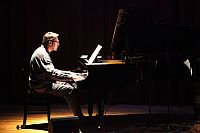 Bader: Above I said your music is beautiful. But to specify your way of composing, we also have to say, there are also some harsh parts in it. What´s your opinion about the term “contrast“?
Madsen: I believe in contrast. One of the things I use in both my composing and my ideas about improvising is the word contrast. “Gravity“ is full of contrasts. There are difficult composed sections and then varying types of improvising sections. There are sections of complete freedom, for example every piece has a freely improvised introduction by one instrumentalist as well as on some of the solos within the pieces. But then there are improvised sections that utilize very difficult chord progressions. I love contrasts in dynamics as well. Recording the piece was not easy for the engineer as he said the dynamics were so wide. I also used many different scales for writing the melodies to again create a contrasting sound from piece to piece. I love beauty and ugliness in music as well. Dissonance and consonance are two supremely important ideas for me. I think that is why often people don’t understand me as I like so many varied contrasting ideas. Even in the NYC jazz world I sometimes have had a hard time because I like too many wide ideas. The critics or musicians can’t pidgeon-hole me into a genre because I like too many different things. I love to go out and play with African musicians or funk musicians and jazz players from old style to new. For me it is all great music and I love the challenge and excitement of all these great musicians I can learn so much from.
Bader: I think your approach to mix traditional or accoustic sounds and electronics is rather new. In my opinion it is a mixture of captivating, enchanting sounds with sounds which can unsettle the listener. There are played dissonances, as example, when Simon Frick turns loose, and dissonances because of the application of electronics.
Madsen: I have been fascinated with electronics since I bought my first Fender Rhodes and then DX7 many years ago. I also had a friend who was working on the ARP 2600 when I was in College and then in NY I had another friend who was working with the super power (at the time) old Fairlight synthesizer in the early 80s. I thought they were such cool instruments. Over the years I have been fascinated by electronics from the theramin to the Hammond Organ to Stockhausen to Pierre Schaeffer’s Musicque Concrete to John Cage and Morton Feldman. I remember hearing a jazz piano player mic an acoustic piano and then run it through a modulator. This idea stayed in my mind for a long time until I promoted this idea to David Helbock who I got into electronics near the beginning of his studies with me about ten years ago.
Bader: Did you learn to arrange the strings-ensemble at university? Did you arrange strings before? Or was it the first time?
Madsen: I had no teacher for my instrumentation, arrangement and composition of the string quartet. I had written about 500 pieces before in a Real Book fashion with melody and chord symbols, but I never knew a lot about arranging. One of the reasons I started the CIA six years ago was to give myself the opportunity to work on my arranging skills. I needed a group to write for and this was a great chance for me. Shortly after I started the CIA with my 14 piece ensemble I wrote a 4 movement symphony. This was my first real chance writing for strings. I also arranged a piece for string orchestra and choir which was performed at the church in Höchst where I live. And then I started a workshop teaching improvisation for strings and I arranged a number of pieces for them as well. I guess you could say I learn by doing. I have pretty good ears and then I found that a lot of my various jazz piano voicings work well when writing for strings. Don’t forget that I was a double bass major at my University, believe it or not, so I know quite a bit about strings in general. Of course, I´m not a Stravinsky yet but I love the struggle forward.
Bader: How long did the composing and arranging take?
Madsen: Hundreds of hours.
Bader: You call your composition “the dante suite“ in the subtitle. A suite as we know it from the Baroque is originally a progression of – stylized – dances, like gique, sarabende etc. Do you see the several – 8 – pieces of your seven movement suite as “dances“?
Madsen: In the jazz world the usage of the word suite has come to describe a collection of related movements that together form a whole large piece. But not necessarily as dances. But I guess now that you mention it each piece in „Gravity“ has a different kind of groove that is related to dance and if you can dance in 11/8 why not…they do in Eastern Europe!
Bader: By the way: It´s a seven movement suite, but there are 8 pieces…
Madsen: It´s a seven movement suite as there are seven sins. The eighth added sin is really an encore piece, an encore invented sin! So the title “swiss chocolate“ is not really part of the “Dante Suite“!
Bader: I can see four units in “Gravity“, three of them at a time with titles and: subtitles. As example: First unit – Title: “excessive love“, subtitles: “1) jealousy 2) hubris 3) rage.“ The fourth unit in my opinion is number 8) “swiss chocolate“. – These titles und subtitles evoke the association that we have program music, some kind of “programmatic suite“ in front of us. I remember Gustav Holst´s programmatic suite “The planets“. Also in Jazz there are programmatic suites, as example: Duke Ellington´s “Far East Suite“ or “Black Brown and Beige“. How big was your claim to be original in the form?
Madsen: I didn’t really write the music with a focus on the way the parts related within each section. I was only somewhat concerned about that but I did write each piece to relate to each of the Seven Sins. In my writing I tried to capture the feeling within me when I feel jealous for example, a bit of sadness and irritation because I don’t have something that someone else does and disappointment with myself because I don’t feel worthy enough and so on. Each piece I tried to get into the feeling of the sin and then write the music from that feeling. But each piece relates to each other and as a whole I think because I wrote all the music about the same time and what I had written before was still in my head. So overall there is a feeling of relatedness as one big piece. The eighth piece “swiss chocolate” I wrote as a kind of encore and to have a little fun as I love chocolate too much and feels like a major sin for me! Have you noticed that it is the only piece that is in a major key? But, as I wanted to still give the feeling of sin the very last chord is minor. You know chocolate when you first eat it and it melts in your mouth and the sugar sinks in and oh it is so good and then after you eat too much like I do you feel a bit sick. Also did you notice the much longer pause between the 7th and 8th piece? The 7th piece is the last movement of the Suite to me and I wanted a feeling of a break before the 8th started which is more like an encore.
Bader: Back to the programmatic question: Let me know something about the intellectual background. Why did you choose the topic of “Seven Deadly Sins“?
Madsen: I´m fascinated by all kinds of religions: As structure-makers of societies all around the world. There was a brilliant writer on religion and myth in the USA named Joseph Campbell whose books I have read extensively and learned so much from. For me the ideas of sin and forgiveness are fascinating to study as they were used and still are used to both teach and control people within our western society. I asked myself, how has the idea of sin affected me personally by simply living in this Western society which is structured so much by Christianity as well as from my early association with the church? What my parents taught me as right and wrong comes directly from the church and I am fascinated and concerned with how it still touches my every breath. The compositions in “Gravity“ are not meant as a political statement or a statement against the church. I only meant to shed a little musical light on the issue, a reminder for people to think about it once again.
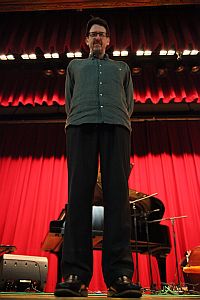 Bader: How much time did you spend with research?
Madsen: About ten days…
Bader: Did you read all of Dante Alighieri´s “Divina commedia“? Or only the part “Inferno“, from where you took the “Seven Deadly Sins“? Did you read secondary literature?
Madsen: I actually read parts of the whole work but not the whole thing. But mostly I focused on the “Inferno“. I did read a lot what other people wrote about the work and found out how important it is to the literature of the world as well as how much it has given people the popular version of the Seven Sins and how the church even deals with them today. I did read that the Catholic Church is at this very moment discussing how to revise the Seven Sins which I am curious to hear about. But I am no expert on the Seven Sins. I really just wanted to get a feeling of what Dante was thinking about and how that could touch my music.
Bader: Back to the question of the beginning. You had to choose – pragmatically – another name for your composition to be able to publish it. The subtitle is “the dante suite“. With this change of the title, a change of the context came. Are there differences between Dante´s execution of the subject and the interpretation of the bible?
Madsen: Dante uses different words for the sins (at least as they are translated into English). As example. In the bible you read “wrath“ in Dante´s “Inferno“ you read “rage“. Dante thought that ones purpose in life was to honor God with your love and he saw that each sin was a kind of weight that pulled you further away from this love of God and more towards the depths of hell.
Bader: Can you tell us a little bit more about your musical interpretation of Dante´s text?
Madsen: As I said earlier I generally tried to capture the feeling of each sin. To capture some of this feeling for example I used different scales that evoke certain feelings in me. For example I used the 5th mode of the harmonic minor scale which has a little bit the sound of the Middle East which is also where Christianity began. During the recording I reminded the musicians about each piece/sin so that their solos could have a certain feeling of that sin. For example I reminded the cellist Bianca Riesner to “get greedy“ just before she played her intro on “Over Indulgence“ as her first couple of takes were too “nice“.
Bader: How long did the recording session take?
Madsen: We recorded 2 days on December 19th and 20th, 2011. By the way: I recorded a Duo-CD with Alfred Vogel at the end of the second day after being totally exhausted that sounds incredible. It is called “Soul of the Undergroud“ and the release date will be March of 2013 and will also be on Playscape-Recordings.
Bader: Where did you record the CD?
Madsen: At the Starship Sudios in Weiler, Vorarlberg, Austria. It was mixed by Little Konzett and me at Little Big Beat Studios, on 29. Februar 2012. Also in Weiler, Austria. Little Konzett did the mastering at Little Big Beat Studios, 4. April 2012.
Bader: A pragmatic question. The production of a CD is expensive. Can you get back the costs of the production with such an ambitious, challenging, demanding and sophisticated work? Or is it idealism?
Madsen: We couldn´t have done the CD-Production without the support for the CIA by the Vorarlberger Landesregierung. I thank them endlessly. As example: All the 8 CIA ensembles which I write, arrange, direct and organize exist because of the money given us by the government. And then there is my Monday-jazz-workshop open to the public that is also sponsored by this government money. And of course: It is idealism!
Bader: When is the CD-presentation?
Madsen: On January 24th 2013! It will be part of the 3-day CIA-festival at the Theater Kosmos in Bregenz with six different bands. After each concert there will be a performance of my Silent Movie Ensemble with the final late night performance on the 26th of an old silent-porno-movie from the 1920‘s. I like to be a little provocative…
Bader: Peter, thanks for the interview!
Madsen: It was a pleasure.