
Abundant with voices either of Russian or Ukrainian descent, Vienna in May recalls an atmosphere from cinematic endeavors of Carol Reed’s “Third Man” or Dragan Bjelogrlic’s “Shadows over Balkan”. Enthused in a rather different way is composer ANTON IAKHONTOV, as this year literally brings him chills. Next to the tormenting news of a grand guignol of an 8-year-lasting-war, tearing to pieces the panoramas of both Kyiv and Lviv that doubled for the landscapes of famous urban counterparts in works of European cinema, this year also marks the 70th anniversary of pioneering works of electronic music.
Vladimir Ussachevsky, a Russian emigree in New York, according to the writer Bruce Duffle, produced the first works of ‘tape music,’ a uniquely American synthesis of the French musique-concrète and the German pure electronic schools. In the words of legendary Italian polymath Pierro Scaruffi, “The first ever concert of electronic music was held in May 1952 in New York, and featured works by the organizer, Vladimir Ussachevsky (USA, 1911)”.
At the doorstep of forties, a Russian cross-platform artist Anton Iakhontov has already made his name as an international video- and sound-artist and composer. Born and raised in Penza, an industrial town 625 kilometers southeast from Moscow, to a father journalist and mother an engineer, Iakhontov inhabits a world empowered by his pseudonym Patrick K.-H. It is a swift hommage to art practices of constructivism and cubo-futurism that he adopted as a teen who experimented with cut-tape and stop-motion animation, as the footage of his earliest work implies. While my blue-eyed interviewee pronounces the name of his birthplace as ‘piensa’, I wondered if he was coming from somewhere much southern, like Pienza in Tuscany. A rare bird who nests in Viennese and Transatlantic art-circles quite well, belongs to a line of post-Soviet composers and performers whose roaming existence caters either to bricks of Wienerberg and/or Vienna International Center, not the least Sainkho Namtchylak or Marina Polyeukhina. Next to teaching at Media Performance lab in Moscow MOMA and later in St. Petersburg, since ten years he is an artistic director of Alexandrinsky Theatre in St. Petersburg, while being a full-fledged performer on live-laptop, no-input-mixer, analogue synthesizers and various types of pick-ups. Patrick’s You Tube channel sums his oeuvre quite well: starting on archive of Acousmonium, next to Curse of Knowledge, an anti-lockdown series of online conferences with kruzhok of his colleagues, it also presents his „Tommy D” animation series, next to a batch of music videos. Not the least, his project of a Floating Sound Gallery has just secured its permanent state of being.
As far as the Google goes, „Overtranslation” (lasting series since 2004) is his threshold composition. On one hand, it echoes anecdotal onomatopoeia of Hans Reichel, another multifarious maverick of European new music, while it follows a wavy line that begins with Vladimir Ussachensky’s early electronic music experiments (happy 70th anniversary, btw!) all over to Jon Appleton’s Sinclavier endeavors of „World Music Theatre”. Namely, Appleton was Iakhontov’s teacher at Moscow Conservatory, Lehrgang he graduated cum laude as a sound-producer at GITR film & Television university. Upon moving to Moscow, Iakhontov develops his interests started in middle 1990s as an improv guitarist, a founder and composer of ´Beligriush´ orchestra. Dipping into a field of electroacoustics shortly came to the fore, upon his studies and participation in workshops of Theremin Center for Electroacoustic Music that Appleton has established. Mentorships with Francois Bayle in Paris, and Stanislav Kreichi in Moscow followed, next to further research along Daniel Teruggi (GRM’s director from 1997-2017) and Michael J. Schumacher (Diapason Gallery, NYC). Fluent in interactive forms, auditive as much as visual, Iakhontov’s daroga took him into a world of animation and video, live-acousmatic performance, and it is understandable that his reputation is affirmed by participation at hundreds of American and European festivals and residences. Not the least, he is an author of sound installation for A. Kallima’s „Rain Theoreme” presented at Russian pavillion of 53rd Biennale in Venice in 2009. Beyond his artwork, Anton has developed an important activity regarding experimental media-art, particularly spatial sound-art education and gallerism: his SoundArt@GogolFest program (Kyiv, 2010) has been pivotal in engendering sound-art as formal and informal practice in the post-soviet domain; shortly after an outburst of recent war operations in Ukraine, Iakhontov presented a work of these over a solo-recital way down yonder in the catacombs of MdW Klangtheater under the Anton-Webern-Platz.
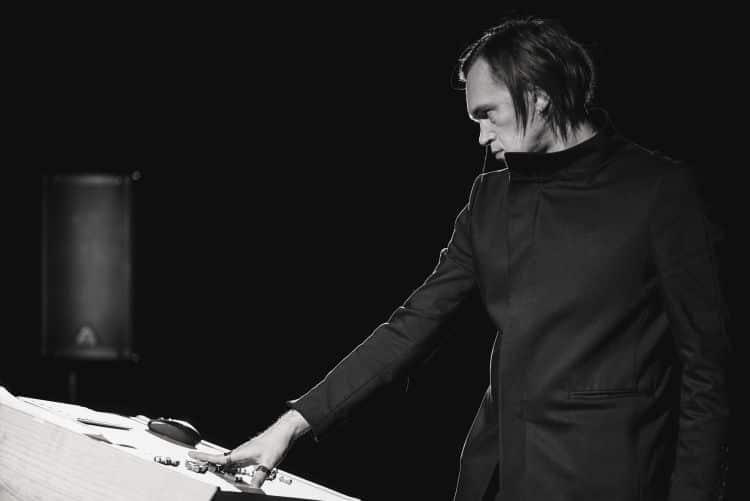
Who is Patrick K.-H., actually?
„Now, Patrick was a nickname that I adopted in my teens… A friend has once introduced me as Patrick to another guy, and the K-H, I would add later… It was funny, because Patrick, as a name, doesn’t exist in Russian tradition at all…….”
How was it growing up in the 80s, during the decay of the Soviet Union?
„There’s nothing much to regret about old Russia. I only regret that all this space was not better used, as it has this great potential and the inhabitants are hard-working people. But, it just couldn’t produce anything, next to failing at creating a decent standard of living for a human being. The USSR was just one big lie….”
Personally, I would identify Russian culture against the names of the giants whom I learned about at school. For Perestroika-period, as they call the times leading to a downfall of the USSR, resonates with Sergey Kuryokhin and Vladimir Tarasov… Where are these artists now and what was meant to be an artist at the time when McDonalds opened in Pushkin’s Square, not so far away from Krasniyi Ploschad?
„Kurehin (Kuryokhinby Russian scription – VJ), whom you mention, remains as a great name, but it was not really a good time to be an artist at all. Not many of those names that I looked up to as a kid, persisted. They would all vanish, as it was not a way to make a living. People would rather strive to try out in sales, or as entrepreneurs… Tarasov’s trio stopped yet in 1986, while I was in a jazz class at music school in Piensa in 1991. My second instrument was jazz guitar and the teacher was supplying us with experimental music. It was John Cage, Coltrane, Art Pepper and then Tarasov whom I would work with in 2011. In theater, I would be a video-artist with him making music in Sochi, Kazan, Moscow, St-Petersburg, and also other way around, cos Tarasov is a video- artist, too. I became involved with other people from his circles such as Mark Pekarsky, or Alexei Lyubimov from Moscow; it was so cool, he is a great guy! Lyubimov’s concert would be interrupted recently by police when he performed works by a Ukrainian composer. It was very dangerous in this time to go into this stuff, at least talking of Schaeffer or Schnittke. Pekarsky would go to prison for that. The others would always find a way of how to get away with it. Tarasov would move to Vilnius, while Pekarsky would seek refuge by doing early music. Kurehin’s spirit was always around, I mean having a framework and doing happenings on stage. For Tarasov, that’s exactly what the term ‘jazz’ suppose to mean.”
How was it to find this music, I wonder, because at one point this would be given away in school. Which standards were working for it to happen?
“Some people were letting me listen to interesting music, as people would cut music on RTG-plates to be played on a regular vinyl player, that was before me. In my time there were cassettes, at some point there were people across town who fell under certain genres, but it didn’t mean those people were necessarily connected. Over a cassette of Coil, I would be introduced to The Residents. Jazz people from Piensa would never have Diamanda Galas, but over connection with Ornette Coleman, there was a chance that someone had it. Therefore, music was a social tool, that tells about social code, sexual code, dress code, and your expectations of life. The popish shit on disco and radios was for everyone and this just wasn’t for me. Looking back, that’s why I never had allegiance to any speciffic group as a teenager, I was looking for something – to be found. It is sad now, this narrow-mindedness exists in contemporary genres on a large scale. I didn’t have it as a kid, glad I didn’t know it.”
Besides ongoing collaborations, there are fresh experiences from Slovenia where you have sporadically been working since few years now. After supporting Rdeča Raketa’s act at Saalfelden Jazz by live-video, next to Croatian multimedia artist Ivan Marušić-Klif, you showcased a solo-exhibition in Kamnik. Followed by a presentation of the Acousmonium project in Ljubljana’s Kino Šiška, you had then set to establish a Floating Sound Gallery, next to another event with Rdeča Raketa (at the Elevate festival, Graz) at the Bildende just in mid-April.
“I was aware of Laibach and NSK since I was 14; that was also very groundbreaking stuff for me… I am very impressed by some of their works and I totally relate to Žižek’s that they resurfaced the nightlife of power-structures. I like this way of thinking and it is very cool, as their work is really louder than words. But, apart from this and some visual things like magazines and graphic novels, I started to learn more since arrival in Vienna, the connections and artists, that they were sitting on other artists’ shoulders, actually. I first came to Lubiana with Maja and Matija in 2019. That partly answers a question of Vienna for me, that it is rather close to other places as well. While Lubiana is nearly the same size as my creepy hometown and Lubiana is lively enough. I am always looking forward to going there. And in Lubiana it’s that my work is never considered strange that I am doing visuals and doing sound”.
How do you relate to Inexhaustible Editions, record label that recently started recording site-specific concerts staged at the infamous Yugoslav partisan monuments? If we look at the so-called Spomenik database, against the recent pop-cultural craze that treats them outside of their original context, that was to warn against the atrocities of Second World War, I wonder how do you look at Penderecki’s „Threnody for victims of Hiroshima”, or Paci Dalo’s „1915 Armenian Files”? Is it engaged art or sort of a warning about the texture present at the monuments themselves?
“By February 24th, I couldn’t continue on my projects, it was only then that I understood – what am I doing, actually? I think that at this moment in time, I can relate to the composers who opted for the avant-garde, I mean in terms of language… The aftermath of atrocities and war done in spite of humanity, was the point where the older art couldn’t sustain the chores of the day no more…. I don’t know too many examples of how art can be used in war issues, like Laibach and NSK passports. The war starts happening, so what is the connection, especially when it is your friends. Is there anything you can do?”
Now, I wouldn’t know about that, but the composer closest to that is Stockhausen, I guess. What about him, does he slip among the shelves of your references intentionally? Do you credit him for a reference, and does he stay with or against the so-called „pirates of the institutions”, that one [ignorant like me] may feel he is rather closer to?
“When I first made my Acousmonium in 2018, Bayle was so enthused that he cried with tears and he brought this expression upon the round table. I was surprised that this is the way it goes, there is not really a habitat for electronic music. Desire was there, but there – it isn’t. There was another analogy by [Jean-Claude] Eloy, to experience cinema we have movie-theaters, this is where you do it and where you consume it, circus is also an analogy of this. Electronic music is a bastard of electricity and music, unrecognized by both parents, and so we still roam around. We are sort of homeless. We are pirates, l’ surquit phantome. We hijack the infrastructure of the existing institutions. If we look at many multi-channel institutions they have 8 or 12 channels, apart from theaters that have 40 or 60 speakers easily, that they don’t use for spatial sound. They never do it, they do it for reproduction. Musique concrete started on the radio because of the infrastructure.”
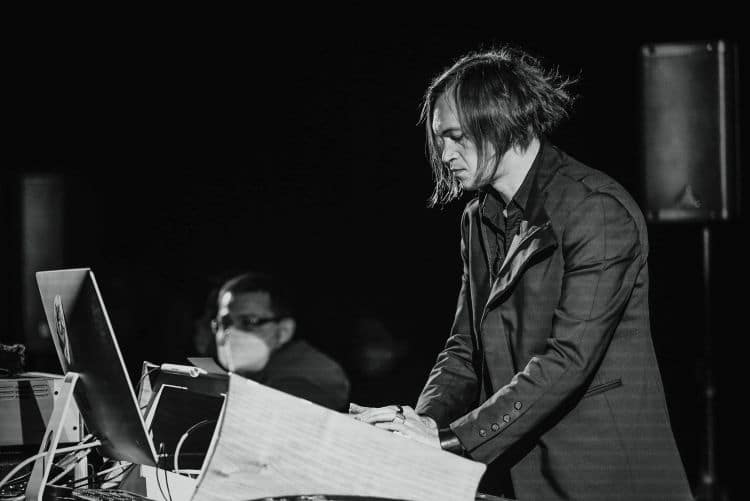
Coolio. I am tempted to talk about „tradition” in electroacoustic music and I wonder which context to refer it to? Are you rather influenced by Polish Electronic Radio or with the Princeton-Columbia Experimental Studio? I ask this in respect to Acousmonium that Teruggi has once introduced as a cinema for the ears, not the least on the track of Schaeffer or Michael Chion…
“I think that the whole western culture and for a better part of the world is still standing on the patents of Bell Laboratories… I didn’t know anything about these names in Penza, it is not very popular, does not reach many people. Why don’t they go for bigger audiences, but they don’t, though sometimes they try. There is a big resistance: instrumental music circles didn’t approve it. I come from Diamanda, Skinny Puppy and Ornette, tape-music was not my thing but it was a confirmation of what I was doing – without knowing what I was doing. The tape was broken and I was fixing it and I was doing collages and then started doing it on purpose as I was in Conservatory. Once you’re a composer you listen and analyze, and fail… You fail better! An option to ‘save’, one couldn’t do without a computer, and then combine it with things you have done yesterday – cos, it is in a file! Options are endless, just this fact changes everything.”
Few Croatian poet-friends who featured their book at Lviv and Kyiv book-fairs, provided rich memories of Ukraine, mentioning the famous Kyiv-Mohyla Academy, also called NaUKMA, as a center of Slavic intellectual elites, next to a „Theatre of Beer”, the famous brewery in Kiev… And the Ukrainian word for artist is, actually, „mitec6”, does it have anything to do with the Mitte?
“My Floating Sound Gallery was not accepted anywhere in the beginning, but then a little door opened in Moscow, and then to Kyiv. I was there in 2009 with my theatre / contemporary dance creation Cinestetika to show at Gogol fest, and interactive-chess performances in 2012, the reception was fantastic, made lot of friends… As I was known for sound art, different practices that don’t fit to anything else, with a program including people from States, Austria, Germany. They gave us a huge garage at Dovzhenko film studio in 2010. It broke the wall! Since then, all the media and press was bringing a crowd, people were very excited. Ukrainian guys helped out a great deal with building stuff. Alla Zagaykevich and ujif_notfound (the composers presented at Anton-Webern-Platz – VJ) helped and participated — that’s how I met them. Ukrainians are very chilled apart from Moscow, that also felt good. I would like to live in the country ruled by the creative class, it must be cool! Saul-turning-to-Paul-situation was also interesting; they accepted the sound-art-community. Since then I was invited very often to Kyiv and Odessa. We had a lot of car tours, it is after Russia the biggest European country with nature and climate zones. And for Lviv, which is a capital of coffee, while Odessa a capital of humor.”
On the interview’s concluding session, we are throwing frisbee in the park at the western end of Mariahilferstrasse. We are joined by Petra Leisentritt, another founding member of Floating Sound Gallery Vienna. „Initially, I was the first person at the students office of the Angewandte that received Anton’s email in 2013… I was also frequent passer-by at the concerts of experimental music. Next to this, I am good at organising and administration and finance stuff, and Anton knows that from Angewandte and else. When we met, he mentioned that he wanted to make a Verein and if it works, I could also do something. That must have been two and a half years ago and when that was clear, I started to make the ‘Statuten’. And then I lost my job, and devoted myself even more to that – it is great, to lose the shit job, I am happy and it is more of a win than a loss…”
What does the artistic landscape of Vienna look like to you? I am interested in process-based development of an institutional thru non-institutional, as where I was coming from, it was mostly that non-institutional would outcome what the institutional rather couldn’t be bothered with?
“It is really very different, a disposition in this case of art is really different, looking from any other point. Just as an example, what it looks like from Croatian side. But, you sort of imply the same, while it doesn’t. People from Vienna might think their way, it goes the same in Russia, while it doesn’t, like, ‘Why do you Russians, if you don’t like Putin, why do you keep electing him?’. They transpose local situation over Russian and ask the wrong question. Because the mindset is wrong. The way it works here, doesn’t work the other way around. And the same about financial situation in art, the same about education. If you come to Germany or Austria and you want to work as a professional artist, so they ask for your diploma. In Germany even more, since that proves where you belong. But, the huge list of these professions never started in Russia. In fact, and all the more education: sound-art, video-art, multi-channel music, electronic music, contemporary dance, you can continue on and on. There are people that do it, and they can be as ever more accomplished, but legally, from magistrat’s point of view it doesn’t count at all. And not because they’re evil minded, but it only shows that the system here works quite well. But, since you were lucky to be born here, you might have an interest in art, you always find a way to find a degree at university and get it. But, it’s completely different in Russia, either in England or in Croatia. You don’t have to convince them with your diploma in Great Britain: this is a social democracy and there’s liberal, while in Russia we have dictatorship – this whole system doesn’t match. Of course it is fun, to experience that and I was teaching a lot, and I enjoy doing this, like in MoMA, St. Petersburg or private and festival classes in Sochi, Krasnoyarsk… It is not because I have degree in that, but because I have worked on it very much. And then I researched something and I found something, and shared it with the people; I wish this is the future of the humanity. As a curator in Russia, you learn that there is no support and even when there is, as an honest person, you don’t want to have it to sell yourself to Putin, cos then you support Kremlin, as much as war in Ukraine. But, otherwise, you do look for other opportunities, and in that case, it is a sort of a activism; these kind of advantages and bugs in the system to use it for yourself. Why not to use all of the existing social-media tools and also guerilla promotion”.
PL. “What I see here is that there are things that are very institutional and very administrative. It is just a load of work that doesn’t have to do with art at all. And also a level of, ‘but, we have to find a way of how to put it in word and promote it, etc’…“
What about the system you came up with in institutions? Did your professors come for the concerts where you played, say, noise-music with improvising ensembles?
“John Appleton, sure, we did many concerts together, as much as theatre performances, as well. And, Teruggi, also sure, he is my coucher of Acousmonium festival business. We work on program for a year before the festival goes on, we know the pieces of each others. He knows it even better, and solves issues on the spot as they come. And always gives feedback to each other.”
Of all the Austrian composers the person whom you got to work out with on so many different layers was probably Burkhard Stangl, not only a composer, but a scientist and even a renaissance man. Sounds like your ideal counterpart?
“We work since 2010, first call was when I was doing sound art at Gogol Fest in Kiev, actually. I had a first Skype with it. I was in middle of big stress, cos festival was meant to be much less than it got to be, eventually, and there was a lot of chaos produced by this expansion of the festival and ended up that I was not only responsible for my pavillion, but I felt myself in charge for all these poor artists coming, like, to the other parts of the festival’s and not being brought up from the train station. …or not cared by others at all, I just fell like their father, if I can – I showed. That’s the way I met also wonderful artists that I am still in contact with. That was an early September 2010 from Kiev, and he was here, in Vienna. I was in Dovzhenko studio with my huge computer. Afterwards, we would meet here late November, early December for a project at Brut Karlsplatz that was fantastic, really! For me, it also meant a big surprise, in terms of contacts, what is it to be a person of this merit in Austria and then in Russia. In Russia you don’t have the chances to grow into this social persona, like it is rather different.“
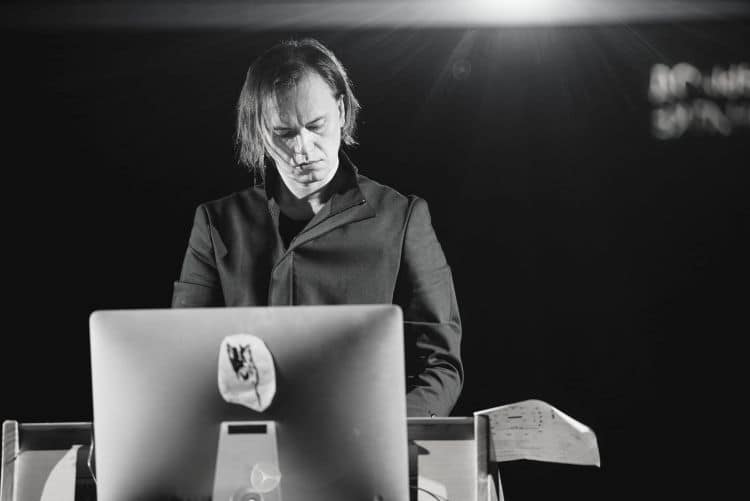
True, I recall his composition was played by Cantus Ensemble in Opatija International Music Tribune in 2016, along with works of Austrian composers, such as Matthias Kranebitter and the like. Though, the initial encounter was the „Schnee” recording with Christoph Kurzmann, where he played guitar with textures from Max/MSP.
“On one hand, I have my own love-hate relationship with guitar… I start it and then stop, love it back and hate it even harder. And then come some other qualities, which meant for me another important eye-opening experience. During this period, our collaboration opened very many things for me as a guitar player. We worked on different layers, guitar and video, piano and electronics, then different instruments. But for me as a composer-musician, helped to sort out what else the guitar might be. Starting form non-playing it, just staying there with it, and on practical, this knowing of what John Cage did, but how do I place it into a part of a concert that it really makes for a context of a concert altogether, you know? Not doing much, even anything, spontaneous, non-idiomatic, free-improvisation. Later on, I come to some discouraging conclusions about the scene of free-improvisation; you can’t place Burkhard in that field, cos he grew out really distinctively.“
He has a very special persona, doesn’t he?
“True. We made also some animations together, one of which won something in Spain, for 2-minute animation „La main: l’heure de la pieuvre”, also played an Italian festival „Music against Mafia”. He published a very thick book „Hommage a Moi”, together with three discs and DVD in 2010; I am very proud to be in that. Animation came a bit later cos in this residency and exchange it distributed this video around. We would make performances with lot of screens, animation with Burkhard’s drawings, film footage we made together etc. You ask himself how he defines, and everything we did at the time was shared. In fact, an institutional framework is that one is a musician, while other is a video-artist, but that didn’t stay this way. We would be both musicians, also live, both as video-artist. So, we were absolutely equally involved on terms of organistion, video, and playing music. Main difference is that I am doing it regularly and he probably doesn’t. Many times we were doing the music things with him, he would do the video-part, as well.“
You have just announced a video for Martina Claussen who will perform in Jerusalem.
“Martina went alone, I just handed her a video out. We have met seven, eight years ago at the class of Thomas Grill at University. She is singing professor at MDW since ever, but she wanted to learn the electronic things and thats how we have met. We have performed yet, some of these concerts happening now are organized already before Corona.“
The other day I was thinking about this moment when women are saving the generation crisis in avant-garde… and how it all started with tape-music and electronic music, actually. What do you think of it?
“I think an electronic music, as much as electroacoustic is a great facilitator in this respect, as in a blindfold test, cos you don’t see who was playing, but either you like it or don’t like it. It could have been the guy you hated or say, a girl, but you read it later. But it is you just liked it or you don’t like it. That is beautiful about acousmatic, cos you don’t see Pithagoras, you don’t see who is doing it. Nowadays, it could be a neuro-network, you just like it or you don’t like it. And that is the point of art. The same was with jazz on the radio in America of the 1930s. As it was on the radio, the white audience liked it although they haven’t bothered who was playing it and then that brought the segregation thing closer. It opened doors to those people, cos people liked it, it was on the radio, it was on the records, it was in their houses. You had to deal with that, whatever the Ku Klux Klan you were.“
How did you get to know about Austrian filmmaker Gustav Deutsch?
“Also thru Burkhard, as he has once brought a DVD of his work to Moscow in July 2011. And a bottle of schnapps. We were sitting in my kitchen, cooking, he is also rather good at cooking and watching it… Instead of preparing our own show – it was a mood creation for us. „Film ist…”, the movie by Gustav Deutsch is a big one, rather long, with music composed by different musicians and Burkhard was one of them. And it is fantastic, just fantastic!“
How would you present him?
“For me, it is a shame that these great Austrian artists are relatively unknown to the world; I don’t know why is that… There is a small movement of so-called ‘directors without the camera’, but I know this framework of Cherkassky and Martin Arnold, and then Gustav Deutsch. He is not very uniform, I have my approach to his films, I never thought of making it from side of presenter. Unfortunately, we had a very few meetings before he died in November 2019. Collage-art is a big connection between Gustav’s partner Hanna Schimeck and me. I do collages every day – it is my metabolism, maybe it is more direct than music; it has zero time dimension. While music lasts, collage doesn’t have it.“
Vid Jeraj
++++
Link:
Patrick K.-H.
Patrick K.-H. (Soundcloud)